What Is Bio Filler? PRP-Derived Dermal Filler Explained | BBAIM
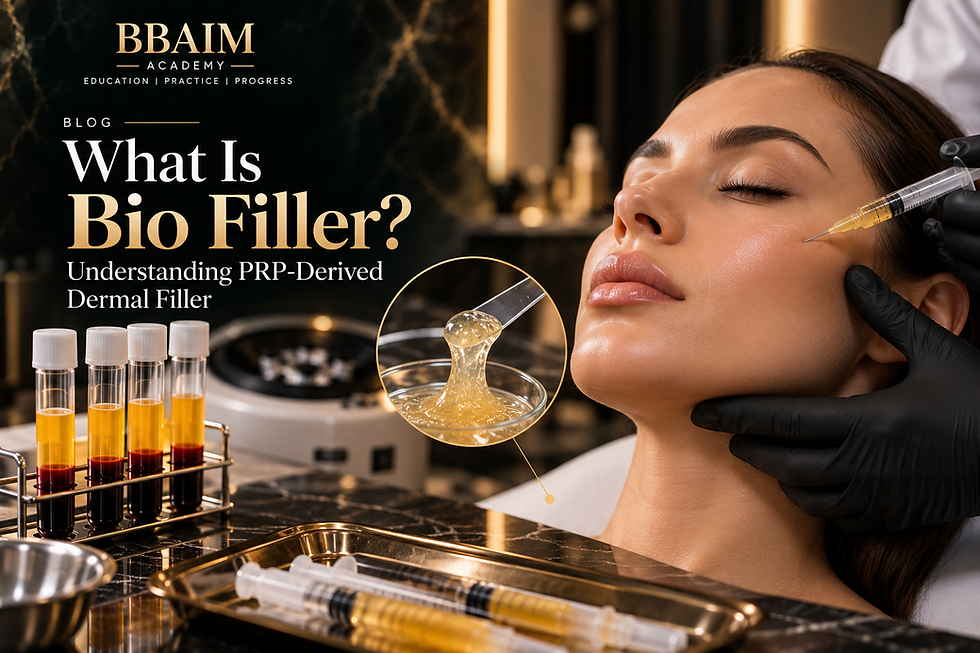
What Is Bio Filler? Understanding PRP-Derived Dermal Filler
Regenerative aesthetics continues to introduce techniques that use a patient’s own biological material in aesthetic practice. One increasingly discussed approach is Bio Filler, also known as autologous plasma gel or blood-derived biofiller.
Unlike conventional dermal fillers made from manufactured materials such as hyaluronic acid, Bio Filler is prepared from components of the patient’s own blood, which are processed to create a gel-like material suitable for soft-tissue augmentation. Recent research describes autologous biofillers as a developing area of regenerative aesthetics, while also highlighting the need for greater standardisation and further clinical research.
How Does Bio Filler Work?
The terminology and preparation methods used for Bio Filler vary. Published studies describe plasma-derived gels prepared from platelet-rich or platelet-poor plasma, depending on the protocol. The processed plasma develops a gel-like consistency that can provide a filling or volumising effect.
This makes Bio Filler different from standard liquid PRP. While PRP is primarily investigated for its regenerative applications, plasma gel is intended to combine autologous biological material with a physical soft-tissue augmentation effect.
Bio Filler vs Traditional Dermal Filler
Hyaluronic acid dermal fillers and autologous Bio Fillers are not interchangeable treatments.
Traditional dermal fillers use manufactured injectable materials formulated for predictable tissue augmentation. Bio Filler, by contrast, is blood-derived and prepared individually from the patient. Current research has explored its use for facial rejuvenation, wrinkle reduction, infraorbital restoration and improvements in skin quality.
The evidence remains developing. A recent systematic review found encouraging outcomes but significant variation in terminology, preparation methods, indications and outcome reporting, meaning practitioners should avoid assuming that every Bio Filler protocol produces equivalent results.
What Should Aesthetic Practitioners Know?
Practitioners interested in Bio Filler need more than injection technique. Appropriate education should cover blood handling, preparation protocols, facial anatomy, patient assessment, contraindications, aseptic technique, treatment planning and complications management.
At BBAIM Academy in Knightsbridge, London, Bio Filler is introduced theoretically within our Regenerative Medicine training, while practical dermal filler skills are covered within relevant Dermal Filler training.
Frequently Asked Questions
Is Bio Filler the same as PRP?No. The terms and protocols vary, but plasma-based Bio Filler generally involves processing blood-derived plasma into a gel-like material for soft-tissue augmentation.
Is Bio Filler the same as hyaluronic acid filler?No. Bio Filler is autologous and blood-derived, whereas conventional HA fillers are manufactured hyaluronic acid products.
Is Bio Filler permanent?No. Published research describes it as a resorbable approach, and longevity varies according to preparation and treatment protocol.
Explore Regenerative Aesthetics Training in London
Want to understand the science behind Bio Filler, PRP and regenerative aesthetics? Contact BBAIM Academy in Knightsbridge, London to explore our Regenerative Medicine and aesthetic training programmes.